AI Doesn't Replace Your Job. It Changes Who Gets It. (Part 1 of 6)
TL;DR: Most of the AI jobs debate is stuck on the wrong question. It keeps asking how many jobs vanish. I think the bigger story right now is that AI removes friction, and that quietly changes which people the work flows to. This is part one of a six-part series where I work through what I'm seeing in real time.

For those who prefer the director's cut, keep on reading.
The debate about artificial intelligence usually circles the same drain: how many jobs disappear. Do developers become redundant? Do lawyers, analysts, designers and consultants get replaced? I think that debate misses the most important thing happening right now.
AI isn't just about automation. It's about less friction.
I work in IT, with a background as a developer, consultant, product manager and architect. Less than a year ago I watched a lot of developers be openly skeptical of AI. Some called it hype. Some called it cheating. A few were outright hostile. Now I bump into many of those same people at the coffee machine, and they thank me for being early with my perspective.
Living in comforting denial
Despite these individual awakenings, the broader picture is strangely disconnected. A recent KPMG AI survey in Norway (April 2026) captured this. The phrase that stuck with me when I first saw the numbers summarized was still living in comforting denial, and I think it fits.
According to the poll, 73% of respondents believe their daily work will be quite similar in five years. At the same time, 69% report having no formal training in AI at work, and 65% say top management in their company lacks an ambitious AI strategy.

I might be over-interpreting this, but here is my perspective: Many employees who use AI tools individually feel a real gain. But employers and management do not see or capture that gain at scale yet, leaving the majority of the workforce believing their daily life will remain unchanged.
The flip side of this denial is opportunity. Those who choose to understand AI technology now, and actively figure out how to weave it into existing processes, are getting a massive head start. In any competitive market, that gap is going to matter.
It's not because AI writes magic prompts for us.
It's because the workday simply feels different.
So what actually changed?
Here's the honest part. The biggest change for me isn't that AI writes documents or code faster. It's that the cost of switching context has dropped dramatically. I've written about this before, both about how an AI sidekick tamed the context-switch hydra and about when your agent writes code faster than you can review it.
It used to cost me a lot of mental energy to jump between domains, codebases, specs, customer context, meetings and problems. I had to reload the entire mental model from scratch. Dig into documentation. Read code for hours before I could produce anything useful.
The biggest cost in knowledge work is rarely the task itself. It's the time it takes to climb back into it after you got interrupted. (There's one obvious exception: when you're actively learning something new, that still takes real time. But AI itself can be a great teacher, which shortens the ramp-up.)
Now I can use AI to scout ahead before I go deep myself. I get a draft structure in seconds. I work on content instead of staring at a blank page. I can talk through possible solutions with an agent before I commit, and get a complex code area summarized before I even open the files. I also tell my agent to keep working until they need a human-in-the-loop decision or input from me. The agent is the tool in the process. I am the worker, and the one who decides.
I don't write two-word prompts
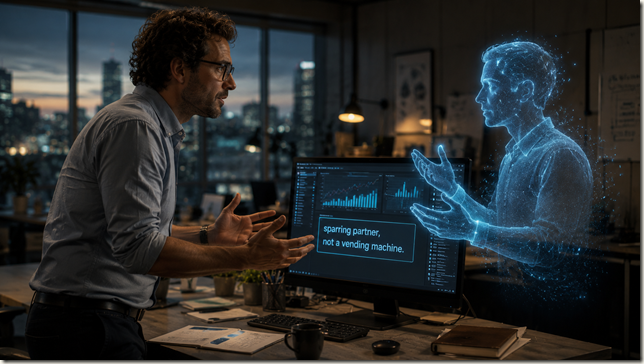
I want to kill one myth right away. I don't type two words and hope for the best. I use AI as a sparring partner. I describe problems in detail, I push back on the solutions, and I work my way toward an answer.
Anecdotally, I recently created a PowerPoint presentation for a conference using an agentic flow. The session itself, Search, then Chat: How Copilot Orchestrates Answers, is about exactly this kind of grounding: how an LLM gets useful by reaching into real data instead of guessing from training. Fitting, then, that the deck for it was built the same way. I started with my topic and abstract, allowed the agent to ground itself in work data I have on the topic, and then added a brain dump of what I planned to present and demo. The resulting deck was the best I have ever made in terms of flow and content, and the session it powered scored 4.68 out of 5 in attendee feedback.
Research was pulled in and verified in an extra step by sub-agents, but also manually by me. All facts have to be validated, always. Nothing weird about that. Even timing and speaker notes were added, allowing me to focus on the actual demos and the session flow. I had it all in my head already; I just needed it structured.
For me this means I solve both small and large problems faster. Not necessarily because I got smarter, but because the friction between thought and action got lower.
That's the whole thesis of this series. People keep framing AI as a machine that deletes roles. I think the more interesting effect is that AI is a friction remover, and friction has never been evenly distributed. Some people swim in it. Some people drown in it. AI changes who's swimming.
And in case it helps: I didn't actually learn to swim properly until I was an adult. So it's never too late to learn to swim in AI either.
Where this is going
Over the next five posts I'll dig into the parts of this that I keep arguing about with people at the coffee machine:
- Part 2: Why the real win isn't faster output, it's cheaper context-switching (and what the research actually says).
- Part 3: Who AI actually favors, and who it quietly squeezes.
- Part 4: The strange situation where society has too few and too many people at the same time.
- Part 5: Consultants, context-switching, and what kind of value survives.
- Part 6: Human in the loop. When to replace, when to keep, and why.
I'm not writing this because I think I'm holding the answer key. I'm writing it because I'm watching the change happen in real time, and I'd rather think out loud than pretend I have it figured out.
People don't become worthless. But some kinds of value get cheaper. That's the thread I'll pull on for the rest of the series.
Next up, part 2: the context-switch tax, and why I stopped trusting "AI made task A faster" as the right way to measure anything.
Stay tuned :)