If You're Not Using AI at Work, You're Stealing From Your Employer (and Five Other Things I Believe)
...and if your employer is denying you AI tools, they are robbing themselves.

Back in April 2025 I said something close to this in an internal Teams meeting where we were discussing AI tooling: "if you're not using GitHub Copilot, you are stealing time from Microsoft." A few people took it very, very badly. My manager backed me up. A year on, with the tools an order of magnitude better and the gap between users and non-users wider than ever, I mean it more, not less. So I am generalizing the line and putting it out here.
TL;DR: AI is not mainly a job-killer. It is a friction remover that changes who the work flows to, and it exposes where your organization was already slow. The interesting question is no longer "how many jobs disappear," but "who does the work flow to now, and where do the loops actually break?" One catch worth flagging early: if AI absorbs the entry-level work, we stop training the juniors who become tomorrow's seniors, and the squeeze comes back later. This post is the front door. The full argument runs across six parts. Read as much or as little as you want.
The 30-second version
Denmark used to have two radiologists read every breast cancer screening. Today an AI system triages around 70% of the lowest-risk mammograms so a single experienced radiologist signs them off. More cancers found. Fewer false alarms. Workload cut by a third to a half. The same result has since shown up at much larger scale, including a UK study of 175,000 women. And notably, this is predictive AI doing one narrow job well, not a chatbot. The human is still in the loop. The loop just got redesigned around what only the human should do.
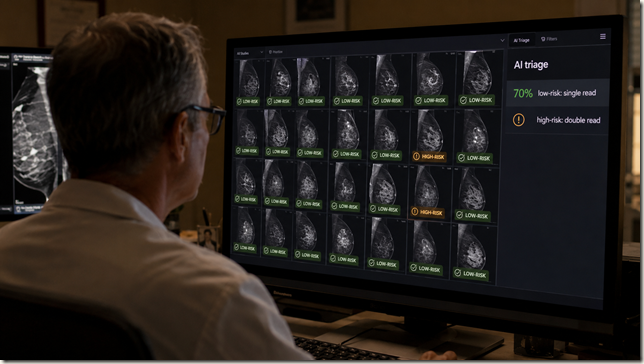
That, in miniature, is what I think is actually happening with AI at work.
Meanwhile, on my own desk: I can produce a one-pager explaining a complex API change in minutes. The document then sits for weeks waiting on the right people in the right rooms to agree to agree before anyone is even allowed to read it. AI did its job. The org chart did not.
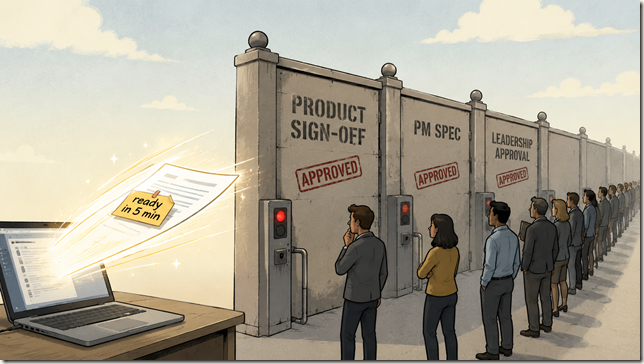
I work at Microsoft. I am not going to pretend we are bad at this, because we are not, but we are large, and large means many hoops to jump through. Small organizations with actual decision authority may have a real and underrated advantage right now. Not because their AI is better, but because their loops are shorter and their people are not always too busy to say yes to a smart idea.
Those two stories are what this series is all about. Where AI lands well, the work flows to different people and the loops get tighter. Where AI lands badly, it makes painfully visible that the bottleneck was never the artifact. It was the humans coordinating around it.
What I actually believe
- The AI jobs debate keeps asking the wrong question. The interesting effect is not "how many jobs vanish," it is "who does the work now flow to."
- The real productivity win for me is not faster output. It is a lower mental cost of jumping between tasks, what we call cheaper context-switching.
- The gains are uneven. AI favors people who thrive on tempo, many contexts and complexity, and puts pressure on those who need stable, predictable surfaces.
- Society has a strange shape right now: too few people for some work, too many for other work, at the same time.
- The consultant role does not die. The "I sell hours" version of it gets exposed. The "I bring patterns and context fast" version gets more valuable.
- Human in the loop is not a magic phrase. It is a design question. Why is the human there? Judgment, trust, legal, or habit?
Not from the CEO podium
Quick note on where I'm writing from, because it matters. I'm not carrying water for Sam Altman, Elon Musk or Dario Amodei. Those three say a lot of conflicting things about both gain and danger, often in the same month. Altman publicly walked back his own "jobs apocalypse" prediction in May 2026 even as the layoffs kept coming. Amodei called for a global pause on AI development a few days ago, right after Anthropic was valued at $965B. Critics noted that a pause would conveniently slow down competitors. The message from the CEO podium shifts with each funding round and each press cycle. Read it that way.
I write from the end-user side. I use these tools every working day. I can see through the sales pitch and the doom pitch at the same time. What I describe in these six parts is what is actually happening at my desk and around me, not what is being announced at a keynote.
Two things that follow from that:
- AI as a technology is not a bubble. It is too useful, too widely adopted, and too embedded in real workflows for that.
- Some of the companies betting big around it almost certainly are a bubble. Same pattern as the internet. The web was real. Plenty of dot-com darlings were not. Eventually some current AI names will go the same way, regardless of how confident their CEOs sound today.
Whether the largest of them, the big-tech bros at the top of the stack, end up "too big to fail" is a separate question, and not one I have a clean prediction for. I just know it shouldn't be a question we let them answer alone.
The six parts
- Part 1: AI doesn't replace your job. It changes who gets it.
- Part 2: The real win isn't faster output. It's cheaper context-switching.
- Part 3: Who AI actually favors (and who it squeezes).
- Part 4: Society has too few and too many people at once.
- Part 5: Consultants, context-switching, and what survives.
- Part 6: Human in the loop. When to replace, when to keep, and why.
You do not have to read all six to get the point. The TL;DR up top is the point. Each part adds the evidence, the arguments and the lived experience that got me there.
About the "stealing from your employer" line, since people always come back to it: I am not saying every job needs AI in it every minute. I am saying this:
If your work is knowledge work, and a tool exists that meaningfully changes what you can deliver, refusing to learn it on the clock is a choice your employer is paying for.
You do not have to like the framing. But it is worth sitting with for a minute before you dismiss it.
For the rest: the harder lines in this post are deliberate, and I mean them. But I also have a lot of empathy for everyone navigating this right now. My perspective is one of many, and diversity of approaches matters. What I do believe, at the bottom of all of it, is this:
Almost anyone can find at least one AI tool that simplifies at least one thing in their workday. Which means everyone must, or at the very least should, be given the chance to look.
Also in Norwegian: Parts of this thinking have been published in Norwegian, for those who prefer it. The op-ed KI endrer hvem som lykkes i arbeidslivet on digi.no covers much of the workforce angle. The LinkedIn piece Verktøyet forvitrer ikke hjernen din. Latskap gjør det is a reply to Bjørn Stærk's "AI keeps disappointing" critique, defending why I think the framing of skill atrophy is wrong.
Pick the part that itches the most :)