Who AI Actually Favors (and Who It Squeezes) (Part 3 of 6)
TL;DR: The AI productivity gain is real, but it is not evenly distributed. It rewards people who thrive on tempo, many contexts and complexity. It puts pressure on people who need stable, predictable surfaces. The research on AI fatigue and technostress is starting to back what most of us already feel: AI gives and AI takes, and which side wins depends a lot on who you are and what kind of room you work in. That's uncomfortable, and pretending otherwise helps no one.

Part three of a six-part series. Previously: the context-switch tax.
In part two I argued the real win from AI is cheaper context-switching. The natural follow-up is uncomfortable: if that's the win, it lands for some people far more than others.
The gain is uneven
I don't think this effect is evenly distributed at all. People who work across fields, domains and organizations will get far more out of AI than others. It especially favors people who can handle high tempo, many contexts and a lot of complexity. For us (and yes, I count myself firmly in that group) it feels like the brain no longer has to boot up from cold every single time.
So let me say it plainly. AI favors people who enjoy fast context shifts and complexity. It puts pressure on people who need stable, predictable work surfaces.
That does not mean stability and thoroughness become worthless. We still need careful, deep, single-track work. But a lot of jobs will become less stable than they were, and the people in them didn't ask for that.
Faster and more stressed at the same time
I was at a summer party recently, talking to a colleague about exactly this. He told me he was definitely working faster with AI. He also felt more stressed than before. That stuck with me, because for me agentic work feels the opposite. From day one it just felt natural. Low shoulders. Two or three threads in parallel, a calmer head, more done.
Why the gap?
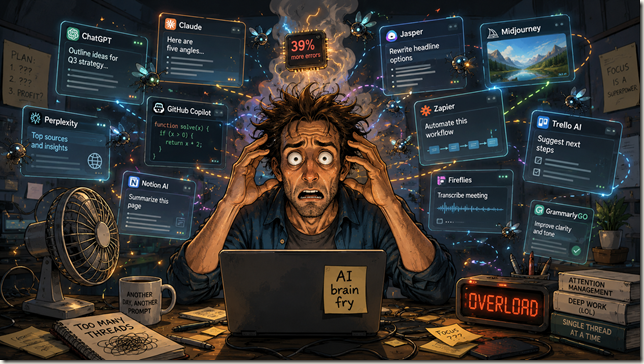
The research is starting to put proper words on this. Multiple 2025 and 2026 papers describe an "AI fatigue" or "technostress" effect that sits right alongside the productivity gain. A BCG Henderson Institute study covered by CNN coined the term "AI brain fry" for mental fatigue from overseeing too many AI tools. Of 1,488 US workers surveyed, 14% reported it, and the affected group made 39% more major errors and were 39% more likely to quit. A separate working paper called "From Gains to Strains" makes the same core point from a different angle. AI introduces new demands at the same time as it removes old friction. Cognitive load can drop in one place and spike in another. Pace goes up. Expectations go up. Boundaries blur. The same tool that gives one person a calmer day gives another person a faster, noisier one.
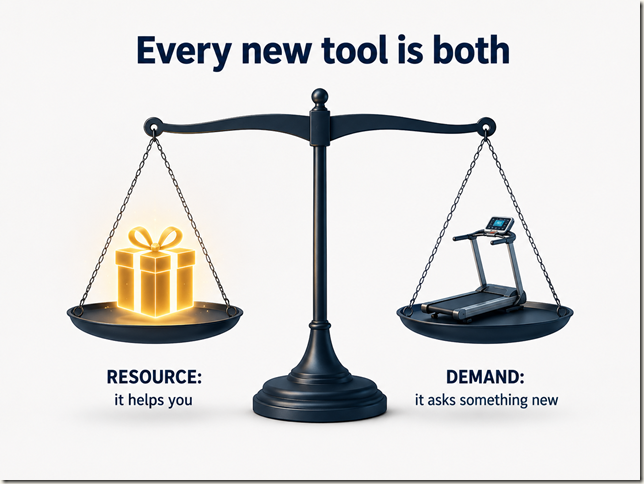
The most useful framing I have seen is the Job Demands-Resources (JD-R) model applied to GenAI by Chuang, Chiang and Lin (2025), a three-wave study of 600 employees across industries. The short version: every new tool is both a resource (it helps you) and a demand (it asks something new of you). For people whose mental wiring or work context lets the resource side dominate, AI feels like a gift. For people where the demand side dominates, AI feels like a treadmill someone quietly sped up.
Their results land on something I find both honest and useful. AI improves productivity either way, through resources directly and indirectly through stress. But the two paths feel very different on the inside. AI resources drive engagement, which lifts job satisfaction. AI technostress drives exhaustion, which lowers job satisfaction and increases work-family conflict.
Same productivity number on the spreadsheet. Two very different lived experiences.
They also found that generative AI tends to dampen the demand side more than older, non-generative AI, mostly because it's easier to use and feels less like a threat. Worth knowing if your organization is rolling things out right now.
When the craft itself is the point
There is one more flavor of this gap that I think gets missed a lot, and it is the one I find hardest to write about because it lands on people I genuinely respect.
I have a very capable colleague, an excellent developer, who feels AI is quietly threatening his existence. Not because he can't use it. He can. But because what gives him joy at work is sitting down with a problem, thinking it through, and writing the code that solves it. That whole arc, from blank page to working solution, is where he goes into the zone. The craft itself is the point for him. Handing off chunks of that arc to an agent doesn't just speed up his day. It removes the part of the day he came for.
I'm not wired the same way. I appreciate brilliant code, but for me the result matters more than who or what produced it, as long as the result is solid. I don't have the same ownership in the lines themselves. What I own are the thoughts, the design, the decisions and the outcome. So AI taking over more of the production part feels like a release, not a loss. For my colleague, it feels like erosion.

Both of these are completely legitimate ways to relate to work. And this is where the diversity question gets harder. I keep saying diversity of working styles is a feature, and I mean it. But will companies actually agree? Or, over time, will they quietly hire toward a more homogeneous group, the people for whom AI feels like a release? I honestly don't know. I expect a few rounds of back and forth before this settles.
I am also aware that I am lucky right now. If someone told me I was no longer delivering enough in a world with AI, I would be sad and shaken. I just don't see that scenario coming for me, at least not soon. That is a privileged position to write from, and I want to name it. Equality in this kind of transition is not simple. It is not even clear which level we should be trying to be equal at.
Is it just attitude, or is it something else?
It is tempting to say "this is mostly about mindset, lean in and you'll be fine." I don't think that's honest.
A few things I notice when I look at the people around me, including myself:
- Personality matters. Some of us are wired for tempo and many threads. Others get cognitive whiplash from the same setup. "Born this way" is unfashionable to say out loud, but it's a real piece of the picture.
- Habit matters. A lot of what looks like aptitude is just practice. People who have spent years switching between projects, customers and stacks already had this muscle. AI just amplifies it. People who built a career on deep single-track work have to build the muscle from scratch, and that takes time and patience that most workplaces don't grant.
- Unspoken expectations matter, a lot. If your manager (or your inner critic) has silently moved the bar from "finish a thing" to "finish three things, in parallel, while keeping up with the chat," the AI did not stress you out. The expectation did. AI is just the carrier wave.
- Imposter syndrome makes it worse. If you feel you are not allowed to ask out loud "how do I use this for my work," you end up copying someone else's flow that doesn't fit you, then judging yourself for struggling with it. The fix isn't more AI training. It's a workplace where you can say "I haven't figured this out yet for what I do" without it counting against you.
- Psychological safety matters. Same as above, scaled up to the team. Teams that can openly experiment, fail small, share what didn't work, and adjust the bar accordingly, get the gain without the brain fry. Teams that have to look productive on top of being productive get both.
So no, it is not just attitude. It is some attitude, some wiring, some practice, some leadership, some culture. And honestly, some plain luck about which job you happen to be in right now.
Which is also why I'm careful when I write that AI feels natural to me. It does. But "low shoulders from day one" is not advice I can hand to anyone. It is a description of where my wiring, my role, my manager and my work setup happened to line up well. Other people have a harder version of the same problem through no fault of their own.
Accommodation, not just adoption
This is where I think most workplaces are still asking the wrong question. The question I keep hearing is "how do we get our people to adopt AI?" The better question is "how do we accommodate the fact that our people are not all the same?"
We already accept this for the physical workspace. We have rules and standards for chairs, screens, lighting, heating, sound, accessibility. We don't expect everyone to perform equally well in a poorly lit room on a bad chair, and we don't blame the worker who struggles in those conditions. We invest in the environment so the work can happen.
AI deserves the same thinking. Not as a perk and not as a mandate, but as workplace accommodation.
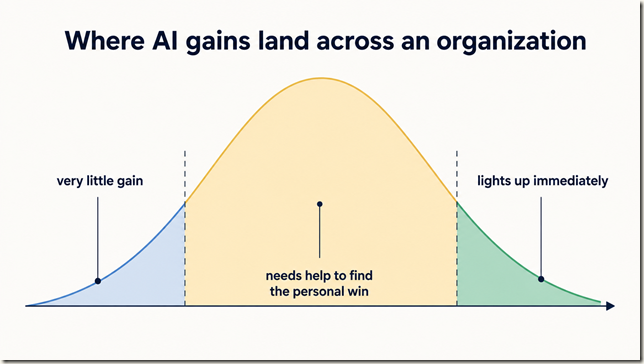
If you map AI gains across an organization, you almost certainly get something close to a normal distribution. Some people light up immediately and run with it. Some people get very little from it no matter what you put in front of them. Most people sit in the middle and need real help to figure out which tool, in which part of their day, gives them a real, personal win. A one-size-fits-all rollout serves the people on the left tail of the curve, sometimes the people on the right tail, and almost nobody in the middle.
What I think actually works:
- Treat AI tooling as a workplace standard, not a perk. Just like a good chair and a working screen, AI access should be the default for knowledge work. Not the reward for the keen ones.
- Write principles, not mandates. Guidelines that say what we expect AI to be used for (and not used for), with room for individuals to find their fit. People follow principles better than they follow orders.
- Invest in finding the personal win. Most people need a guided session, not a generic course. The question "what is the one thing in your week that AI could make easier?" is more useful than any 30-minute corporate training video.
- Lead with empathy over compliance. The bell curve is real. The person who isn't using AI yet is usually not a slacker. They are someone who hasn't found their fit, or hasn't been given a workplace where it is safe to try and to fail.
- Acknowledge the people on the tail who genuinely won't benefit much. It is honest to say that some roles, in some seasons of life, are not where the gain lands. The strategy is not to drag them through it. The strategy is to make sure the loss isn't theirs to carry.
This is what I meant in the front-door post when I said employers who deny AI tools are robbing themselves. It is the same logic as denying someone a good monitor. The work suffers, the worker suffers, and the organization quietly pays the bill in both directions.
"AI turns developers into architects" is a bit too neat
People don't become worthless. But certain kinds of value get cheaper.
This is also why I think the popular line about AI turning developers into architects, summed up neatly in pieces like this one in TechGig and echoed across LinkedIn, is slightly misleading. There is a real pull. Strong developers do get pushed toward higher-level design and orchestration work. But not everyone can, wants to, or gets that role.
What AI really does is let one person with broad system understanding handle far more complexity than before. That can mean fewer traditional developer roles over time. And maybe more importantly: fewer pure office roles in general.
There's a generational edge to this too. If the entry-level work is exactly what AI absorbs first, juniors lose the rung they used to climb on, and the squeeze quietly becomes a pipeline problem for everyone later. I come back to that in part four.
The squeeze is real, and it's personal
If AI makes large parts of knowledge work more efficient, we may need fewer people for coordination, reporting and administration. That's brutal for the people it hits. Losing a role, or an identity, is hard. I'm not going to dress that up.
It's easy to talk about transformation in the abstract. It's harder to stand inside it.
So I want to be honest about the shape of this. The gain is uneven. It clusters around people who were already comfortable with chaos, and it thins out under people who built careers on predictability. If you only read the cheerful version of the AI story, you miss that half of the room is getting a much worse deal than the other half.
That's not an argument against AI. It's an argument for being clear-eyed about who carries the cost.
In part four I want to zoom out from the individual to the whole society, because at that level the picture gets genuinely strange: we may end up short on people and oversupplied with people at the same time.
More soon :)