Consultants, Context-Switching, and What Survives (Part 5 of 6)
TL;DR: AI changes how consultants work and who wins at it. The timeseller who just bills hours gets more exposed. The curious builder who reads context fast, carries patterns between projects, and turns ideas into working loops gets more valuable. And if AI one day makes my own role redundant, I think that's genuinely fine. I've changed roles plenty of times already.

Part five of a six-part series. Previously: too few and too many people at once.
I've spent four posts arguing that AI is mostly a friction remover that rewards people comfortable with tempo and many contexts. Time to land it where I actually live, consulting. Or technically, where I used to live, with a long enough shadow that the way I work today still looks like it.
We misunderstand what good consultants do
In the public sector there's constant talk about cutting consultant spend. Sometimes for good reason. Consultants shouldn't replace permanent expertise, and organizations need to own their own decisions.
But after many years as a consultant, and many conversations with other consultants, I think we often misunderstand what good consultants actually do.
For the record: I'm not technically a consultant anymore. I've been at Microsoft for seven years, in a permanent role. But the way I work still looks much like it did in consulting. I help out here and there, where it's needed, across projects and teams. Three internal roles and seven managers later, I keep landing on something new because I follow projects and opportunities. AI today is part of why that works. It lets me get into new projects faster and keep an overview across them.
When I ask experienced consultants what the ideal project length is, many say three to six months. That's usually enough to understand the problem, find patterns and build momentum. After that, many want to move on. Not because they're disloyal, but because they like getting into something new. For a lot of us, a permanent role isn't the goal. The goal is new problems, new context and fast learning.
Why AI makes this arrangement stronger
A lot of good consultants create value because they handle context-switching well and have seen many variants of the same problem. AI makes this way of working stronger, not weaker.
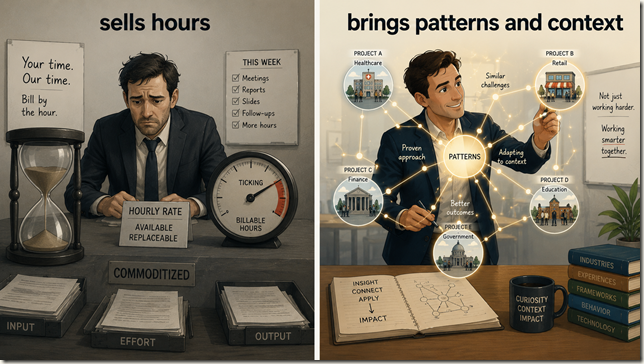
Agents can read up while the consultant talks to people. They can check code while the consultant weighs a solution. They can keep several threads warm at once. The consultant stays the human in the loop, but on more threads at the same time. So the consultant's most important quality stops being "delivers the most hours" and becomes "asks the right questions and connects patterns fast."
The employees know the organization and the people. The consultant brings an outside view and speed. I'm not defending consultant spend uncritically. I'm defending the difference between renting hours and bringing in specialist competence from outside.
And here's where I think AI sharpens the difference. The mediocre consultant who only sells hours gets more exposed. The curious one who understands context and carries what they've learned elsewhere can become far more valuable.
This clicked for me in a conversation with a former colleague who immediately leaned into what I'd call the builder persona. The people who get energy from seeing a messy need, shaping a solution, and then watching it come alive in the real world. He has side projects where agents monitor for new information, auto-send request emails when criteria are met, and then escalate only the moments that actually need judgment. Human in the loop, but for the right moments. That's the pattern I keep seeing: AI is best when it handles the repetitive plumbing so a human can spend attention on decisions, direction and accountability.
What survives
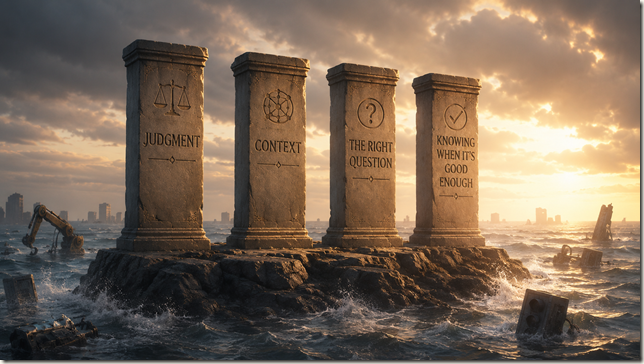
So what actually survives all of this? Not "writing code," at least not as the core value. What survives is judgment, context, asking the right question, and knowing when something is good enough. The human glue that AI can scout for but not replace.
It's easy to talk about transformation. Harder to stand in it.
If AI one day makes my own role redundant, I honestly think that's fine. Then I'll have to find something else to do. I've already changed roles many times. Maybe I'll have to do it again. (Updating my own rules when reality moves is kind of a habit. Years ago I had a "rule of three" for SharePoint search. The platform shifted, I bumped into a new edge case, and I had to admit it was actually a rule of four. Same dance, much bigger stakes now.)
But I think it's hard to argue this one blows over.
I don't believe AI primarily replaces people. I believe it changes which people society needs more of.
And that, after five parts, is the whole point I've been circling. The question was never "how many jobs disappear." It was always "who does the work flow to now?"
Thanks for sticking with me this far. If it made you think, or made you argue with me at your own coffee machine, that's a win in my book :)
One more post, because the question that keeps coming up in the comments is: where exactly does the human still belong in the loop? Part 6 takes that on directly.