Society Has Too Few and Too Many People at Once (Part 4 of 6)
TL;DR: At the individual level the AI squeeze looks bleak. Zoom out to society and it gets stranger, and maybe less bleak. We already lack people in health, care and the trades. If AI frees up knowledge workers, maybe some of that labor moves toward work that needs human presence. There's a catch in the pipeline, though: if we stop hiring and training juniors, the shortage just reappears later. I think it mostly self-corrects, but that's cold comfort for whoever graduates into the dip. Easy to say at the macro level. Harder for the person living it.

Part four of a six-part series. Previously: who AI favors and who it squeezes.
Part three ended on a hard note: some people get squeezed, and that's personal. But when I step back and look at society as a whole, I'm honestly not sure the overall direction is negative.
Short on people and oversupplied with people
We already lack people in healthcare, schools, elderly care and the trades. The World Health Organization projects a global healthcare workforce shortage of at least 10 million by 2030, with upper estimates over 78 million, a figure McKinsey Health Institute uses as the starting point for its 2025 report on the healthcare workforce of the future. The OECD Employment Outlook 2025 frames population ageing as one of the defining megatrends, pushing the old-age dependency ratio to unprecedented levels across the OECD over the next 35 years. Meanwhile the WEF Future of Jobs Report 2025, based on input from 1,000+ employers across 22 industries and 55 economies, makes the two-sided shape concrete. They project 170 million new jobs created and 92 million displaced by 2030, a net gain of 78 million. The largest declines, in absolute numbers, hit clerical and secretarial roles: cashiers, ticket clerks, administrative assistants, executive secretaries, bank tellers, data entry clerks. The fastest growth, alongside tech roles, sits squarely in the care economy: nurses, social workers, personal care aides, teachers.
Put those side by side and you get a strange shape: a shortage of people and a surplus of people at the same time. Too few in health, care and craft. Too many in parts of the knowledge economy.
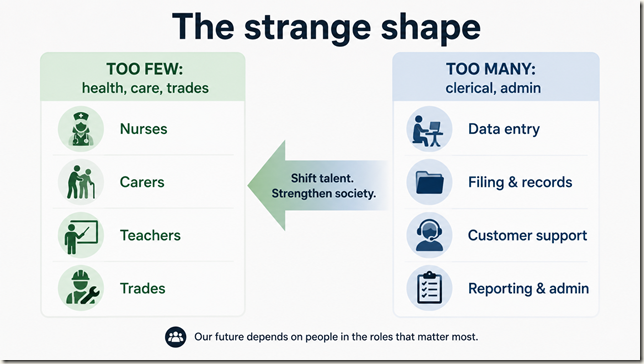
Read that twice, because it sounds like a contradiction and it isn't. Maybe part of the gain from AI is that labor gradually shifts toward work that requires human presence, care and trust.
Work that's hard to automate because the human in the room is the point.
(That phrase is doing double duty on purpose. "Human in the room" here, "human in the loop" in part six. Same underlying question. When is the human the bottleneck, and when is the human the point?)
But the macro view is cheap
It's easy to say all that at the level of society. For the individual it can mean something much less comfortable: young people pushed toward educations that lead to jobs, not the jobs they actually want.
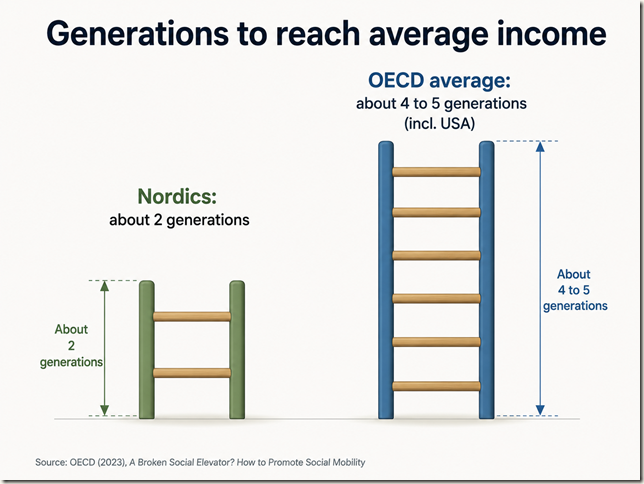
That's not new. Plenty of generations have made pragmatic choices about what pays. But it does challenge a particular kind of "you can become anything you want" story. In the Nordic model that belief is genuinely close to reality. The OECD report A Broken Social Elevator? How to Promote Social Mobility estimates it takes about 2 generations for children from the bottom income decile in the Nordic countries to reach average earnings, versus 4 to 5 generations on OECD average, with the US sitting around the OECD average despite the cultural script of the American Dream. OECD's newer 2026 working paper using fresh PIAAC survey data reaches the same conclusion with different methods: the Nordics are consistently the most mobile, while Chile, Israel and Latvia are the least, and parental background still influences children's earnings even when education is held constant. The Great Gatsby Curve research and the paper bluntly titled The Scandinavian Fantasy both make the point: the country selling mobility hardest, the U.S., has less of it than it thinks, and the country quietly doing it well rarely gets the credit. If AI narrows which paths lead to work, the Nordic version of that promise takes a real hit. The American version was a comforting story to begin with, so the dent there is more about the story than the underlying reality.
The junior squeeze, and why I think it partly self-corrects
One worry I hear a lot: new graduates can't get a foot in the door, and it still takes five to ten years to turn someone into a senior. If AI absorbs the work juniors used to cut their teeth on, where does the next generation of seniors come from?

I'm more optimistic than most here, with one caveat. The hopeful case is that AI can shorten the apprenticeship. A lot of becoming senior is accumulating domain knowledge and structural judgment the slow way, by making mistakes over years. A good model already carries a lot of that structure, especially in programming. It can set up an architecture and, more importantly, explain why. Used well, that turns some hard-won experience into something you can learn faster, by reading what the AI lays out and asking why.
The caveat is the whole game. If a junior treats AI as the answer instead of as a tool and a teacher, they don't build the judgment, they just rent it. That works on a greenfield project where the model is strong. It falls apart in brownfield reality, the messy existing system where you have to know why things are the way they are. And the models keep getting better, which makes the lazy path more tempting, not less.
There's a structural risk on top of the individual one. If companies stop hiring and training young people, whether as consultants or internally, the squeeze just moves in time. People retire. Someone has to replace them. A pipeline you stopped filling ten years ago is not there when you need it. I suspect we get a dip and a correction rather than a permanent break, because the shortage eventually forces hiring again. But "it self-corrects eventually" is cold comfort if you're the cohort that graduated into the dip.
And the harder version, honestly: if enough of these entry-level jobs genuinely disappear to efficiency rather than just shift, then we really do need fewer juniors, and the correction is smaller than the disruption. I don't think that's the whole story, but I won't pretend it isn't part of it.
A tool, with all the problems of tools
Here's the other catch. Because AI is a tool, it carries all the inequality problems tools carry. If only the well-resourced get access to the best tools, AI can amplify inequality instead of reducing it.
There's a darker version of that same risk. What happens when bad actors offer cheap or free AI loaded with hidden propaganda, slanted news framing, or quiet ideological nudges? A free chatbot that helps you write emails and also subtly shapes how you think about a country, a politician, a minority, an election. We have already seen this pattern with social media feeds. AI is a more intimate channel. The "free tool" can be the cheapest delivery vehicle for influence anyone has ever built. People without resources are exactly the people most likely to use whatever is free, which means the inequality problem and the manipulation problem stack on top of each other.
Schools are where this gets sharp. We need to teach the difference between AI as a tool and AI as an oracle. The first one everyone should learn. The second one we should be far more skeptical of. A student who learns to use AI to think faster is in a very different place from one who learns to let AI think for them. And neither of those places is safe if the model itself has been quietly tilted before it ever reached the student.
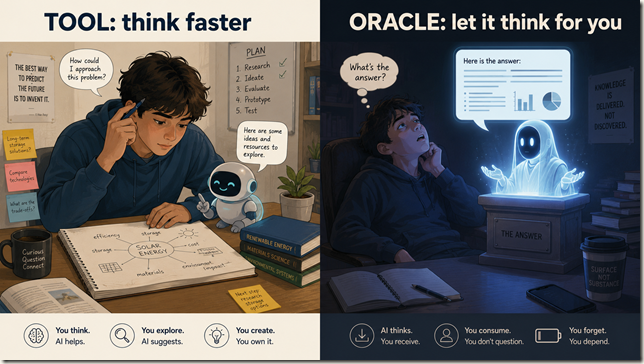
That distinction, tool versus oracle, is going to matter far beyond the classroom. It's basically the whole question of whether AI lifts people up or quietly hollows out their judgment.
So is this good or bad?
Honestly? Both, depending on where you're standing. On the societal ledger I can squint and see labor flowing toward work that's badly understaffed and deeply human. On the individual ledger I see real people who didn't choose this being told their path just narrowed.
Historically, technology has rarely made us stop creating. When something gets cheaper to produce, we raise our ambitions. I think AI does the same. We'll attempt more, experiment more, iterate faster. That's the optimistic read, and I mostly believe it. But "mostly" is doing some work in that sentence.
In part five I'll bring it back to the ground, to my own corner of the world: consultants, context-switching, and what kind of value actually survives all this. Then part six picks up the thread of where humans still belong in the loop.
Two more to go :)